Due to the existence of the Global Interpreter Lock (GIL), LangGraph mainly implements concurrency rather than true multi-core parallelism. Considering that the official documentation extensively uses the term parallelization, to maintain consistency with it, I will still use Parallelization as the title. However, except for the title, where it should be concurrency, I will express it as concurrency to avoid confusion for readers ( ̄O ̄)ノ
This section introduces four ways to implement concurrency:
Node Parallelism
@taskDecoratorMap-reduce
Sub-graphs
Node Parallelism achieves concurrency through parallel nodes; the @task Decorator declares functions as concurrent execution units; Map-reduce uses the Send function to concurrently send parameters to nodes for execution; Sub-graphs achieves concurrency through parallel sub-graphs. There’s always a method that suits you.
import os
import time
import operator
import uuid

from dotenv import load_dotenv
from typing import Annotated
from datetime import datetime
from pydantic import BaseModel
from typing_extensions import TypedDict
from langchain_openai import ChatOpenAI
from langchain.messages import HumanMessage
from langgraph.graph import StateGraph, MessagesState, START, END
from langgraph.types import Send
from langgraph.func import entrypoint, task
from langgraph.checkpoint.memory import InMemorySaver
from IPython.display import Image, display
from concurrent.futures import ThreadPoolExecutor

# Load model configuration
_ = load_dotenv()

# Load model
model_name = "qwen3-max"
llm = ChatOpenAI(
    api_key=os.getenv("DASHSCOPE_API_KEY"),
    base_url=os.getenv("DASHSCOPE_BASE_URL"),
    model=model_name,
    temperature=0.7,
)
1. Node Parallelism
Node parallelism is easy to implement, just use StateGraph to create a workflow with concurrent nodes.
Below is a simple example of node parallelism. You can observe the timestamps of node execution to confirm whether they are truly running concurrently.
# Create concurrent node a
def node_a(state: MessagesState):
    start_time = datetime.now()
    print(f"[node_a] Enter function time: {start_time.strftime('%Y-%m-%d %H:%M:%S.%f')[:-3]}")

    # Use sleep to simulate time consumption
    time.sleep(2)

    end_time = datetime.now()
    print(f"[node_a] Exit function time: {end_time.strftime('%Y-%m-%d %H:%M:%S.%f')[:-3]}")

    return {'messages': [HumanMessage(
        content=f'Node a ran for {round((end_time - start_time).total_seconds(), 3)} seconds'
    )]}

# Create concurrent node b
def node_b(state: MessagesState):
    start_time = datetime.now()
    print(f"[node_b] Enter function time: {start_time.strftime('%Y-%m-%d %H:%M:%S.%f')[:-3]}")

    # Use sleep to simulate time consumption
    time.sleep(4)

    end_time = datetime.now()
    print(f"[node_b] Exit function time: {end_time.strftime('%Y-%m-%d %H:%M:%S.%f')[:-3]}")

    return {'messages': [HumanMessage(
        content=f'Node b ran for {round((end_time - start_time).total_seconds(), 3)} seconds'
    )]}

# Create graph
builder = StateGraph(MessagesState)

# Add nodes
builder.add_node('node_a', node_a)
builder.add_node('node_b', node_b)

# Add edges
builder.add_edge(START, 'node_a')
builder.add_edge(START, 'node_b')
builder.add_edge('node_a', END)
builder.add_edge('node_b', END)

# Compile graph
my_graph = builder.compile(name='my-graph')
my_graph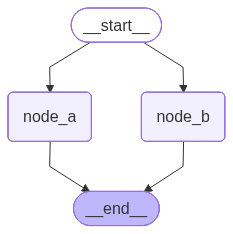
# Invoke graph
response = my_graph.invoke({
    'messages': [HumanMessage(content='Execute node_a and node_b')]
})

for message in response['messages']:
    message.pretty_print()
[node_a] Enter function time: 2026-02-14 18:41:09.896
[node_b] Enter function time: 2026-02-14 18:41:09.897
[node_a] Exit function time: 2026-02-14 18:41:11.901
[node_b] Exit function time: 2026-02-14 18:41:13.902
================================ Human Message =================================
Execute node_a and node_b
================================ Human Message =================================
Node a ran for 2.005 seconds
================================ Human Message =================================
Node b ran for 4.005 seconds
2. @task Decorator
The @task decorator declares the generate_paragraph function as a concurrent execution unit. Calling this function returns a future object. The workflow entry function defined by the @entrypoint decorator can concurrently call multiple generate_paragraph functions and collect the returned future objects.
# Concurrent execution unit
@task
def generate_paragraph(topic: str) -> str:
    response = llm.invoke([
        {"role": "system", "content": "You are an intelligent assistant who can write popular science articles"},
        {"role": "user", "content": (
            f"Write a paragraph about {topic}, approximately 100 words. "
            "What you write is just one paragraph of the entire article, "
            "so please focus on the given topic without introductory text")}
    ])
    return response.content

# Create persistent checkpoint
checkpointer = InMemorySaver()

# Workflow entry function, can concurrently call functions decorated by @task
@entrypoint(checkpointer=checkpointer)
def workflow(topics: list[str]) -> str:
    # Distribute topics to multiple task nodes for concurrent execution
    futures = [generate_paragraph(topic) for topic in topics]
    paragraphs = [f.result() for f in futures]
    return "\n\n".join(paragraphs)

# Run workflow
config = {"configurable": {"thread_id": str(uuid.uuid4())}}
result = workflow.invoke(["What is sea urchin tofu", "How delicious is sea urchin tofu", "Ingredients and preparation of sea urchin tofu"], config=config)
print(result)
Sea urchin tofu, known as *uni tofu* in Japanese cuisine, is a delicate and luxurious dish that combines the creamy, briny richness of fresh sea urchin roe (uni) with the subtle softness of silken tofu. Unlike traditional tofu made solely from soybeans, this version often incorporates uni directly into the tofu mixture or serves it as a topping, creating a harmonious blend of oceanic umami and smooth, custard-like texture. It’s typically enjoyed chilled, garnished with a touch of soy sauce, grated ginger, or chives to enhance its natural flavors without overpowering them. Prized for its refined taste and elegant presentation, sea urchin tofu is a specialty found in high-end Japanese restaurants and reflects the culinary art of balancing simplicity with premium ingredients.
Sea urchin tofu is a luxurious umami bomb that marries the creamy, briny richness of fresh uni with the delicate, silken texture of chilled tofu. The sea urchin melts slightly upon contact, infusing the tofu with a sweet, oceanic depth that’s both subtle and complex. Often served with a light drizzle of soy sauce, a whisper of wasabi, or a sprinkle of scallions, the dish balances elegance and simplicity. Each spoonful delivers a velvety mouthfeel and a lingering savoriness that lingers on the palate—proof that minimal ingredients can yield maximum flavor. It’s a delicacy that feels indulgent yet refined, making it a standout in Japanese kaiseki or high-end izakaya menus.
Sea urchin tofu combines silken tofu with fresh sea urchin roe (uni), prized for its creamy texture and briny sweetness. The dish typically uses chilled, high-quality uni—often sourced from Hokkaido or Santa Barbara—and pairs it with soft, unseasoned tofu to let the sea urchin’s flavor shine. Preparation is minimal: the tofu is gently drained and placed in a bowl, then topped with whole lobes of uni. A light drizzle of soy sauce, a few drops of yuzu juice, or a sprinkle of grated ginger may be added for subtle enhancement, but never enough to overpower the delicate seafood. Served cold, the dish highlights freshness and balance, making it a luxurious yet simple delicacy in Japanese cuisine.
3.1 Create Context Schema
# Roles
class Roles(BaseModel):
    roles: list[str]

# Single role
class Role(BaseModel):
    role: str

# Single response
class Response(BaseModel):
    response: str

# Best response ID
class BestResponse(BaseModel):
    id: int

# Global context
class Overall(TypedDict):
    roles: list[str]
    responses: Annotated[list, operator.add]
    best_response: str
3.2 Create Prompt Templates
# Role prompt
role_prompt = "The goddess hasn't replied to your message again. As a {role}, how should you reply to the goddess in one sentence? Please return in JSON format with a response field"

# Best response prompt
best_response_prompt = """Below are reactions from several types of guys when the goddess doesn't reply to their messages.
Which reply do you think can best win back the goddess's heart? Please return the corresponding ID.
Note that the first reaction corresponds to ID 0. Return in JSON format with an id field.
Here are the guys' reactions:

{responses}"""
3.3 Create Nodes
The magic here is that we use the Send function to distribute roles to the generate_response node for role response generation.
# [MAP] Use Send function to distribute roles
def continue_to_responses(state: Overall):
    return [ Send("generate_response", {"role": r}) for r in state["roles"] ]

# [MAP] Role response node: generate response for each role
def generate_response(state: Role):
    prompt = role_prompt.format(role=state["role"])
    response = llm.with_structured_output(Response).invoke(prompt)
    return {"responses": [response.response]}

# [REDUCE] Best response node: return the best response
def best_response(state: Overall):
    responses = "\n\n".join(state["responses"])
    prompt = best_response_prompt.format(responses=responses)
    response = llm.with_structured_output(BestResponse).invoke(prompt)
    return {"best_response": state["responses"][response.id]}
3.4 Compile Graph
# Define Doge sub-graph output Schema
class DogeOutput(TypedDict):
    roles: list[str]
    responses: list[str]
    best_response: str

# Create graph
doge_builder = StateGraph(Overall, output_schema=DogeOutput)

# Add nodes
doge_builder.add_node("generate_response", generate_response)
doge_builder.add_node("best_response", best_response)

# Add edges
doge_builder.add_conditional_edges(START, continue_to_responses, ["generate_response"])
doge_builder.add_edge("generate_response", "best_response")
doge_builder.add_edge("best_response", END)

# Compile graph
doge_graph = doge_builder.compile(name='best-response')
doge_graph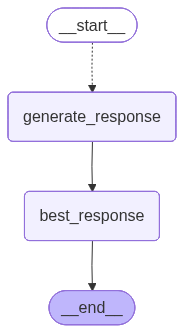
# Invoke graph
roles = ["Dream Guy", "Troll", "Lovestruck Puppy", "Playboy", "Baby-faced Brother", "Socially Anxious Homebody",
         "Dominant CEO", "Tea-themed Guy 💅💅💅", "Artsy Long-haired Guy", "Kawaii Otaku"]
response = doge_graph.invoke({"roles": roles})
# Best response
print(f"Most liked reply by {model_name}: {response['best_response']}")Most liked reply by qwen3-max: I hope I didn’t say anything awkward—just wanted to check in gently, no rush at all to reply!
# All responses
for role, resp in zip(response["roles"], response["responses"]):
print(f"【{role}】")
print(resp)
print()【Dream Guy】
Even in silence, your presence lingers like stardust in my dreams—shall I keep waiting, or shall I dream us a new beginning?
【Troll】
Oh mighty goddess, your silence is so divine—must be why even my trolls bow in awe... or maybe you're just buffering?
【Lovestruck Puppy】
My heart pines for your words like a lost puppy beneath a moonless sky—will you grace me with just a whisper?
【Playboy】
Guess even goddesses need a little more charm to keep them replying—shall I try again with a wink and a better line?
【Baby-faced Brother】
Goddess, your silence is more enchanting than words—but I’ll keep waiting, just in case you’re testing my devotion.
【Socially Anxious Homebody】
I hope I didn’t say anything awkward—just wanted to check in gently, no rush at all to reply!
【Dominant CEO】
I expect a reply by sunset—my patience, like my empire, has limits.
【Tea-themed Guy 💅💅💅】
Darling, even the finest loose-leaf needs time to steep—shall I brew another cup while we wait for your divine reply? 💅🍵✨
【Artsy Long-haired Guy】
Still waiting for your divine reply, goddess—my inkwell’s drying up and my heart’s running low on inspiration without you.
【Kawaii Otaku】
Goddess-sama... did my message get lost in the void of your divine inbox? 🥺✨
4.1 Create a Workflow
Below we create a workflow. Unlike doge_graph which requires specifying personas, it can automatically generate n new personas and generate responses for these personas.
# Define ReAct sub-graph global Schema
class ReActState(TypedDict):
roles: list[str]
n: int
new_roles: list[str]
responses: list[str]
# Divergently generate roles
def generate_roles(state: ReActState):
roles = ", ".join(state["roles"])
n = state["n"]
prompt = (
"Now we're playing a role-playing game about: how to win back the goddess when she doesn't reply to messages. "
f"Reference role list: {roles}, create {n} different roles. "
"You will play these roles later to reply to the goddess. "
"Please return in JSON format with a roles field. "
f"The roles field must be a pure string array with elements being the {n} newly created role names. "
"Only return a JSON object without any explanation or other text."
)
res = llm.with_structured_output(Roles).invoke(prompt)
return {"new_roles": res.roles}
def role_response(role: str) -> str:
prompt = role_prompt.format(role=role)
res = llm.with_structured_output(Response).invoke(prompt)
return res.response
def divergent_thinking(state: ReActState):
with ThreadPoolExecutor(max_workers=8) as executor:
rs = list(executor.map(role_response, state["new_roles"]))
return {"responses": rs}Connect the nodes above to form a workflow.
# Define ReAct sub-graph output Schema
class ReActOutput(TypedDict):
new_roles: list[str]
responses: list[str]
# Create graph
react_builder = StateGraph(
state_schema=ReActState,
output_schema=ReActOutput
)
# Add nodes
react_builder.add_node('generate_roles', generate_roles)
react_builder.add_node('divergent_thinking', divergent_thinking)
# Add edges
react_builder.add_edge(START, 'generate_roles')
react_builder.add_edge('generate_roles', 'divergent_thinking')
react_builder.add_edge('divergent_thinking', END)
# Compile graph
react_graph = react_builder.compile(name='divergent-thinking')
react_graph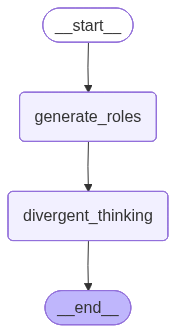
4.2 Test the Workflow
Run this workflow and see if the results meet expectations.
# Invoke graph
res = react_graph.invoke({"roles": roles, "n": 5})
assert len(res["new_roles"]) == len(res["responses"])
for role, resp in zip(res["new_roles"], res["responses"]):
print(f"【{role}】")
print(resp)
print()【Dream Guy】
Even in silence, your presence lingers like stardust in my dreams—shall I keep waiting, or dare I step closer to the divine?
【Troll】
Oh mighty goddess, your silence is so divine—must be why even my trolls bow in awe... or maybe you're just buffering?
【Lovestruck Puppy】
My heart pines for your words like a lost puppy beneath a moonless sky—will you grace me with just a whisper?
【Playboy】
Even silence from a goddess sounds like a sonnet—shall I keep waiting, or shall I charm the stars into delivering my next message?
【Tea-themed Guy 💅💅💅】
Darling, even the finest loose-leaf needs time to steep—shall I brew another cup while we wait for your divine reply? ☕✨
4.3 Run Two Sub-graphs Concurrently
Now we have two workflows: doge_graph and react_graph. Let’s connect them in parallel and put them into a parent graph.
# Parent graph global Schema
class EntryGraphState(TypedDict):
roles: list[str]
n: int
new_roles: list[str]
responses: Annotated[list, operator.add]
best_response: str
# Parent graph best response node: return best response and aggregate roles
def fa_best_response(state: EntryGraphState):
responses = "\n\n".join(state["responses"])
prompt = best_response_prompt.format(responses=responses)
response = llm.with_structured_output(BestResponse).invoke(prompt)
return {
"roles": state["roles"] + state["new_roles"],
"best_response": state["responses"][response.id]
}
# Create parent graph
fa_builder = StateGraph(EntryGraphState)
# Add nodes
fa_builder.add_node("doge_graph", doge_builder.compile())
fa_builder.add_node("react_graph", react_builder.compile())
fa_builder.add_node("fa_best_response", fa_best_response)
# Add edges
fa_builder.add_edge(START, "doge_graph")
fa_builder.add_edge(START, "react_graph")
fa_builder.add_edge("doge_graph", "fa_best_response")
fa_builder.add_edge("react_graph", "fa_best_response")
fa_builder.add_edge("fa_best_response", END)
# Compile graph
fa_graph = fa_builder.compile(name='father-graph')
# Set xray parameter to 1 to display nested graph internal structure
display(Image(fa_graph.get_graph(xray=1).draw_mermaid_png()))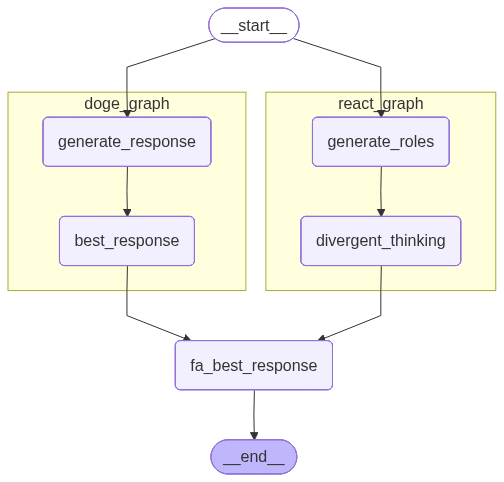
# Invoke graph
response = fa_graph.invoke({"roles": roles[3:6], "n": 5})The best response here is the best response generated from all responses of the two sub-graphs. Do you think its quality has improved? ( ゚∀。)
# Best response
print(f"Most liked reply by {model_name}: {response['best_response']}")
Most liked reply by qwen3-max: I hope I didn’t say anything awkward—just wanted to check in gently, no rush at all to reply!
# All responses
assert len(response["roles"]) == len(response["responses"]), f'{len(response["roles"])} != {len(response["responses"])}'

for role, resp in zip(response["roles"], response["responses"]):
    print(f"【{role}】")
    print(resp)
    print()
【Playboy】
Guess even goddesses need a little more charm to respond—should I send another lightning bolt or just keep waiting like a mortal?
【Baby-faced Brother】
Goddess, your silence is more enchanting than words—but I’ll keep waiting, just in case you’re testing my devotion.
【Socially Anxious Homebody】
I hope I didn’t say anything awkward—just wanted to check in gently, no rush at all to reply!
【Playboy】
Guess even goddesses need a little more charm to respond—should I send my halo or just keep waiting with a smile?
【Baby-faced Brother】
Goddess, your silence is more enchanting than words—but I’ll keep waiting, just in case you’re testing my devotion.
【Socially Anxious Homebody】
I hope I didn’t overstep—just wanted to say I’m still here, quietly admiring from afar.
【Mysterious Artist】
Silence, too, is a brushstroke in the canvas of our conversation—shall I wait for your next hue, or paint my own?
【Devoted Scholar】
O Radiant One, your silence is a sacred mystery I shall contemplate with unwavering devotion until your wisdom deigns to grace me once more.